Koyo Kouoh’s “In Minor Keys” asks the Venice Biennale to shift into a slower gear. But can the art world’s biggest spectacle ever truly embrace subtlety? Charlotte and Esenija explore deceleration, spectacle, and the power of quietness in contemporary art.
Transkript Episode 01, pt I
Hosts Charlotte Desaga (CD) & Esenija Bannan (EB</s
EB: Hello and welcome to Art Unquoted, the podcast that unpacks ideas shaping the world of contemporary art.
CD: We’re your hosts, Charlotte Desaga…
EB: …and Esenija Bannan. We’re two art professionals based in Berlin, and in each episode, we take a single, thought-provoking quote and examine it from different perspectives.
CD: Often, the art world is filled with noise, sometimes the most revealing things are found in a few words. This is Spark and Friction.
EB: For our very first episode, we wanted to start with a quote that will resonate throughout this year. It comes from the late Koyo Kouoh, and it’s the core of her vision for the 2026 Venice Biennale. The title of the exhibition, and our episode, is „In Minor Keys.“ Koyo Kouoh (1967–2025) was a renowned Cameroonian-Swiss curator, cultural producer, and director, celebrated for bridging African and European art worlds. She founded Raw Material Company in Dakar and led Zeitz MOCAA in Cape Town before her untimely death while preparing to curate the 2026 Venice Biennale.
CD: In Minor Keys- A title for an exhibition that hasn’t happened, curated by someone who is tragically no longer with us. There’s a lot of weight there already.
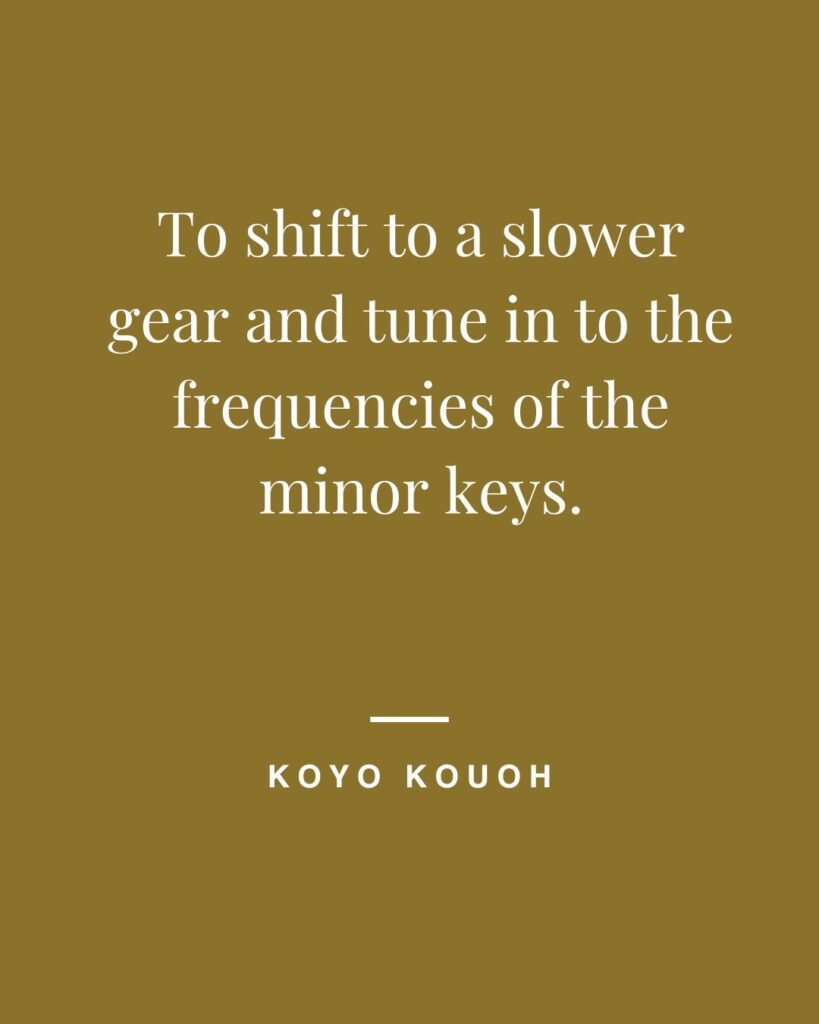
EB: Exactly. And the quote itself is just beautiful. Kouoh wrote: „To shift to a slower gear and tune in to the frequencies of the minor keys.“
CD: You know, philosophers like Paul Virilio for instance have long critiqued the acceleration of contemporary culture, and how that acceleration shapes everything from time-based art to video art to conceptual practice. But Kouoh is actually combining two different things here: shifting to a slower gear is about pace, deceleration. And tuning into the frequencies of minor keys is about emotional tone, melancholy. They’re not quite synonymous, even if they feel poetic together. So yes, it’s evocative language, but is it a precise curatorial concept? Listen, I know this is a rough way to kick off our first episode, but that’s exactly the point, spark and friction.
EB: That’s the spark, right there! For me, it’s a profound and necessary antidote. For years, the art world has found its rhythm in being loud and wanted to be seen, or let’s say: Dominant when present. It’s become relentless, all major keys. Kouoh’s statement is a call to resist that, to embrace the quiet, the complex, the unresolved. When I hear „minor keys,“ I think of melancholy, but not sadness. I think of thoughtfulness, emotional depth, the kind you find in a minor chord. It’s art that doesn’t scream for your attention, but rewards it when you give it.
CD: I understand the appeal. It’s a romantic idea. But my skeptical thoughts about this come to my mind immediately. Sorry, but let’s be brutally honest: this is for the Venice Biennale. The art world’s kind of most prestigious event. Like the Olympics for art. It is the definition of spectacle, of nationalistic competition, of market frenzy and power positions. So, can an event of that scale, with big budgets and pressure behind it, ever truly operate ‘in a minor key’? Or is this just beautiful, poetic branding to make a massive, commercial event feel more soulful than it actually is?
EB: But that’s what makes it so radical! It’s a challenge issued from inside the institution. It’s Kouoh using the biggest platform in the world to question the very values that platform usually promotes. She’s not saying the Biennale is a quiet space; she’s asking us, and the artists, to make it one, to carve out a space for contemplation amidst the noise. It’s an act of resistance.
CD: I see it more as a paradox. And it also risks being elitist. Are we asking the average visitor, who has spent a fortune to get to Venice and is overwhelmed by thousands of artworks, to now also “shift to a slower gear” and appreciate something subtle? It’s a lot to ask. Sometimes a bit of spectacle is generous. It’s a direct, powerful experience. “Minor key” art can sometimes feel like it requires a PhD in art history or at least serious stress level in real life to unlock.
EB: I disagree. I think it’s the opposite of elitist. It’s a return to a universal, human experience of art that’s about feeling, not just understanding. Think of an artist like Agnes Martin. Her grid paintings are the definition of “minor key.” They are quiet, meditative, and demand you to slow down. You don’t need a PhD to be moved by them, but you do need to give them a moment of your time.
CD: Agnes Martin is a great example, and so is someone like Felix Gonzalez-Torres. His work is profoundly emotional and subtle. A pile of candy, a string of lightbulbs… it’s all very “minor key.” But these are artists who are now canonised. Their quietness has been amplified by museums and the market for decades. What happens when you apply that logic to a new und yet unknown artist in Venice? Does their quiet work get lost in the noise of the pavilion next door?
EB: Maybe. But it’s a chance worth taking.
CD: And for every Agnes Martin, there’s a Jeff Koons or a Yayoi Kusama, artists who work exclusively in the major key. Their work is about spectacle (remember Damien Hirsts “Treasures from the Wreck of the Unbelievable” in Venice in 2017?), high production, and immediate impact. Can you deny its power? Kusama’s Infinity Rooms are a global phenomenon precisely because they are overwhelming, immersive spectacles. Pure, immaterial experience. They are the antithesis of this concept, and yet they draw millions.
EB: And that’s fine! But it can’t be the only mode. Kouoh’s vision isn’t about erasing the major key, but about reminding us that there is a whole other spectrum of experience available. It’s about creating balance. And by the way: Times are changing. Also in terms of “spectacle”. Smaller budgets, smaller spectacles…
CD: A balance that, I suspect, will always be tipped in favor of the spectacle. However, I will concede this: the intention is valuable and probably a sign of a growing inward focus. The critique of the art world’s obsession with noise is correct, but it’s getting brittle, agree. The desire to find something more meaningful is something I share, even if I don’t yet trust the container it’s being presented in. Maybe it’s just a bluff package.
EB: So, in the end, Koyo Kouoh’s quote is both a practical challenge and a poetic ideal. It’s a call to change how we look, how we listen and observe, and how we value art. It invites and challenges us to find the power in the stillness, the beauty in the unresolved, and the resonance in the minor keys.
CD: Or, it’s a beautiful melody for an orchestra that’s still playing far too loud. But it’s a melody I’m glad someone tried to compose. And one I’ll be listening in Venice.
EB: Speaking of which, did you see that South Africa cancelled its participation in the 2026 Biennale?
CD: I did. It’s particularly significant given that Kouoh was the former director of the Zeitz Museum in Cape Town, what one might consider her home country. South Africa won’t be there due to concerns about the selected artists‘ exhibition plans.
EB: In a way, that absence is also „in minor keys.“
CD: A sad note in the Venice symphony.
EB: And that’s already all the time we have for today. Thank you for exploring these ideas with us.
CD: Wait! We are not done yet and have many more aspects to discuss. Shall we host a part 2 and 3 of this episode?
EB: Yes, agree! But for now: Join us next time on Art Unquoted.
CD: If you enjoyed this episode, please subscribe to Art Unquoted on Apple Podcasts, Spotify, or wherever you listen to podcasts. And if you could take a moment to rate and review us, it would mean so much, it helps other listeners discover conversations about the art and ideas that matter. We’re back in two weeks. Join us next time on Art Unquoted.
Source of quote: Kouoh, Koyo. „Curatorial Text.“ La Biennale di Venezia, 2026. https://www.labiennale.org/en/art/2026/curatorial-text-koyo-kouoh.