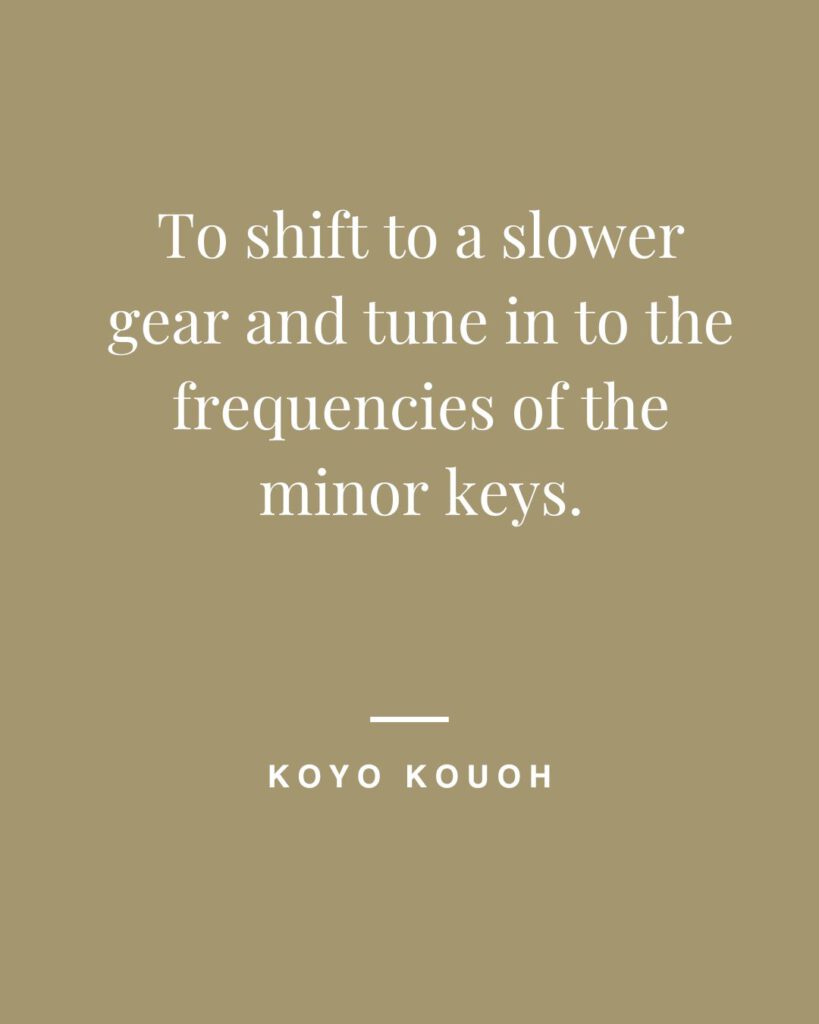
In this episode, Charlotte and Esenija explore the historical and contemporary dimensions of „In Minor Keys.” From Giotto’s 14th-century Cappella degli Scrovegni to Pierre Huyghe’s Liminal at Punta della Dogana, we trace how contemplative, site-specific practice has always demanded slowness. A conversation about finding meaning in Venice’s layered past and present. 🎧 Listen to episode 01, PT. III
Transkript Episode 1, part III
Hosts: Esenija Bannan (EB) & Charlotte Desaga (CD)
EB: We’re still caught up in Venice, exploring the ideas around “In Minor Keys!”, the 61st International Art Exhibition of the Biennale.
CD: Before we continue with contemporary artists, I want to take us back in time. To Padua, about an hour from Venice. There’s a chapel there, the Cappella degli Scrovegni, that I think is the historical precedent for some aspects Kouoh is talking about. If you have time, it is absolutely worth a visit.
EB: A historical precedent? Tell me more.
CD: It was built in the early 1300s by a wealthy banker named Enrico Scrovegni. His father had been mentioned in Dante’s Inferno as a usurer, so Enrico commissioned this chapel as redemption. He hired Giotto di Bondone to decorate it with frescoes between 1304 and 1306.
EB: What makes Giotto’s work so significant?
CD: The humanity. The emotional depth. Giotto brought unprecedented subtlety to religious imagery. There’s a scene where Mary is shown with her head bowed and arms crossed, a gesture of acceptance. You don’t need text. You see it. You feel it. The visual language carries all the meaning.
EB: And the space itself?
CD: The chapel is small, 20 meters long, 8.5 meters wide. Intimate. The ceiling is a barrel vault with a starry blue sky. The architecture is designed to slow you down . Access today is strictly limited. Only small groups, for short periods. The frescoes are fragile. Slowness is enforced through scarcity.
EB: So Giotto was already creating what Kouoh is calling for?
CD: In a way, yes. Seven hundred years before „In Minor Keys,“ he was creating an architectural and visual experience that demanded contemplation. He understood that slowness isn’t a limitation, it’s a strategy. The chapel embodies everything Kouoh is talking about: intimacy, subtlety, visual truth. No noise, no spectacle. Well, the place is in fact spectacular, and in a time with very few images accessible… it must have been very impressive, as it is still today.
EB: And this is relevant to contemporary practice.
CD: It shows that contemplative, site-specific practice isn’t new. It is a great historical example for how to create spaces where people actually slow down and experience something genuine. And where architecture is integral to the experience of the artwork.
EB: Sounds fantastic. It makes me think of the 2024 show Liminal by Pierre Huyghe at Punta della Dogana – to bring us back to contemporary art.
CD: Oh, yes, I remember it clearly!
EB: The exhibition was part of the collateral events during the Venice Art Biennale in 2024. Huyghe created the show in close collaboration with curator Anne Stenne, and it presented new creations alongside works from the last ten years, particularly from the Pinault Collection.
CD: How did you respond to his „post-humanistic“ interrogation of contrasts, reality versus fiction, human cognition versus algorithmic control? I became caught in an atmosphere of the uncanny and couldn’t quite move beyond it emotionally. That said, Huyghe strikes me as perhaps the most accomplished contemporary artist at visualizing the mental and revealing the mystical aspects of existence. In Liminal, he examines spaces that exist between different forms of being and consciousness. The Latin word natura, like the Greek physis, originally meant generating, growing, being born. All that took place in the exhibition, but in the end, I strangely felt untouched by it.
EB: Upon entering the Punta della Dogana, I was completely enveloped by the space. The composition of the exhibition was not overwhelming despite the size and the “heaviness” of some of the themes. A film projected onto a large transparent screen, featuring a nude woman alone outside in the dark, pacing, crawling on the ground, and looking up to the heavens… And it felt that you could get lost without feeling “lost” – you know what I mean? That was so cleverly thought through. I was guided by the exhibition narrative and felt completely at ease with that. The darkness was interrupted abruptly when standing in the room filled with the artist’s aquariums, which was much lighter than the other galleries. Absolutely an enigmatic experience that to this day left an impression on me. Especially since the objects in the exhibition took center stage and the spatial elements became companions. The entire experience did not rely on the space; space did not feel like a space, a gallery or a room. It metamorphosed, but it left me with an atmosphere. I don´t remember the rooms, I remember the feeling.
CD: Yes, we can agree on that. Same here.
EB: Seeing exhibitions in Venice is such a different experience than anywhere else. I remember seeing “open-end,” the monographic exhibition dedicated to Marlene Dumas at Palazzo Grassi, and was struck by how her human figures – often quite elegiac – felt harmonious in the Palazzo. As if the silhouettes were part of the Palazzo. It certainly didn´t feel like a conversation between historical and contemporary, but a melancholy tune with a hint of desire in between. How was it for you, Charlotte? Did any of these exhibitions leave a mark on you? Do you feel that such exhibitions are a bit much in the context of the Biennale? Or a good escape?
CD: I would not distinguish between seeing a show in Venice or at any other place. It’s more that I feel a bit guilty visiting Venice, as the streams of tourists, including myself, have helped to commercialize the city and contributed to the fact that there is almost no normal life for Venetians possible in Venice anymore. But that is for sure a different topic. The shows I have seen at Palazzo Grassi or Punta della Dogana were always impressive due to their comprehensiveness, although I am not always fond of the artists, like the battle of material you could explore 2017 in the Damien Hirst show.
EB: I wish I had the chance to experience the DH exhibition in both venues that he occupied… what a monumental approach.
CD: Yes, definitely. But from my experience, not necessarily enlightening. The works in the Hirst show felt very repetitive. But one of my outstanding memories is Artempo: Where Time Becomes Art at Palazzo Fortuny in 2007. Axel Vervoordt and his co-curators put together an amazing spectrum of works, objects, and historical artifacts, exploring the relationship of art and time. Life and art very close together. Just wonderful! Although not part of the official Biennale, you can quite often find wonderful shows at the palazzi around the city.
EB: My experience working with architecture in a Venetian Palazzo was in 2024 when Walton Ford showed his beautiful paintings at the Ateneo Veneto in Venice in the exhibition titled “Leo Dei.” The images of the lion appear throughout the entire Palazzo and most significantly in Tintoretto’s “Apparizione della Vergine a San Girolamo,” a painting that takes an important role for the work that Ford created for the exhibition. Venice Biennale is the nexus where many topics come together. Between the past and the present… and even AI?
CD: It seems we’ve come full circle, from Giotto’s frescoes to the digital age. And perhaps that’s the real power of Kouoh’s quote. It’s not just about slowing down, but about tuning in to what matters, whether it’s a 700-year-old fresco or a contemporary digital installation. It’s about finding the signal in the noise.
EB: A perfect final thought. That’s all the time we have for today. Join us next time on Art Unquoted.
allation. It’s about finding the signal in the noise.
EB: A perfect final thought. That’s all the time we have for today. Join us next time on Art Unquoted.
Semi-automatically translated.
Source of quote: Kouoh, Koyo. „Curatorial Text.“ La Biennale di Venezia, 2026. https://www.labiennale.org/en/art/2026/curatorial-text-koyo-kouoh.