„Let us believe in the beginning of the hot season.“– Kubra Khademi
A Hazara artist who fled Afghanistan inverts an iconic feminist poem to tell a story of defiance, desire, and radical artistic transformation. Her work turns trauma into manifesto. Available on Apple Podcasts & everywhere else — or right here
Selected works by Kubra Khademi from our archives
Transkript Kubra Khademi
EB: Today, we’re starting with a quote that sounds contradictory. Kubra Khademi (born 1989) a Hazara artist and performer from Afghanistan: „Let us believe in the beginning of the hot season.“ It is inspired by the Iranian poet Forugh Farrokhzad’s poem, „Let us believe in the beginning of the cold season.“ Khademi who explores her life as a refugee and as a woman is taking this iconic, melancholic, feminist work and inverting and adapting it to her own purpose.
CD: She’s turning winter into summer? Turning cold to hot?
EB: And that’s exactly what her work is about. Khademi who had to flee her country in 2015 after a public performance in Kabul. Her work is a celebration of female identity in a male-dominated society. It’s vibrant, it’s defiant, it’s… hot. And yet the quote is more than that, it is based on a film (and exhibition) which is an allegory for the relationship between the US and Afghanistan portrayed through a submissive, abusive, and violent sexual relationship between an American man and a Taliban leader.
CD: Aha. But this is where it gets complicated. There’s a critic, Eddy Frankel, who wrote a piece in Art Review about what he calls the „tyranny of context.“ He argues that we’ve become so focused on an artist’s tragic backstory—their pain, their trauma, their politics—that we’ve forgotten how to actually look at the art. We’re afraid to say something is bad if it’s about something important.
EB: I see his point. You can’t say a painting is bad if it’s about the Holocaust or slavery. You’d be a monster.
CD: Exactly. And Frankel’s argument is that this creates a kind of self-censorship. We’re so busy agreeing with the politics of the work that we forget to ask: is it actually good? Is the art doing anything interesting?
EB: So with Khademi, the context is overwhelming. She’s a Hazara woman, who had to flee her country. She’s a feminist artist challenging a patriarchal society. Her story is so powerful that it’s almost impossible to separate it from the work.
CD: And Frankel would say that’s the problem. We’re so focused on her biography that we might not be looking closely at the works themselves. Are they good paintings? Or do we appreciate them just because of the story behind them?
EB: But I think that’s a false distinction. With an artist like Khademi, the context is the work. Her life, her experience, her politics—they’re not just a backstory. They’re the material she’s working with. You can’t separate them.
CD: I agree, to a point. But Frankel’s argument is that great art has to balance context, concept, and execution. If you lean too heavily on one, the others suffer. And he’s worried that we’re in a moment where context is trumping everything else.
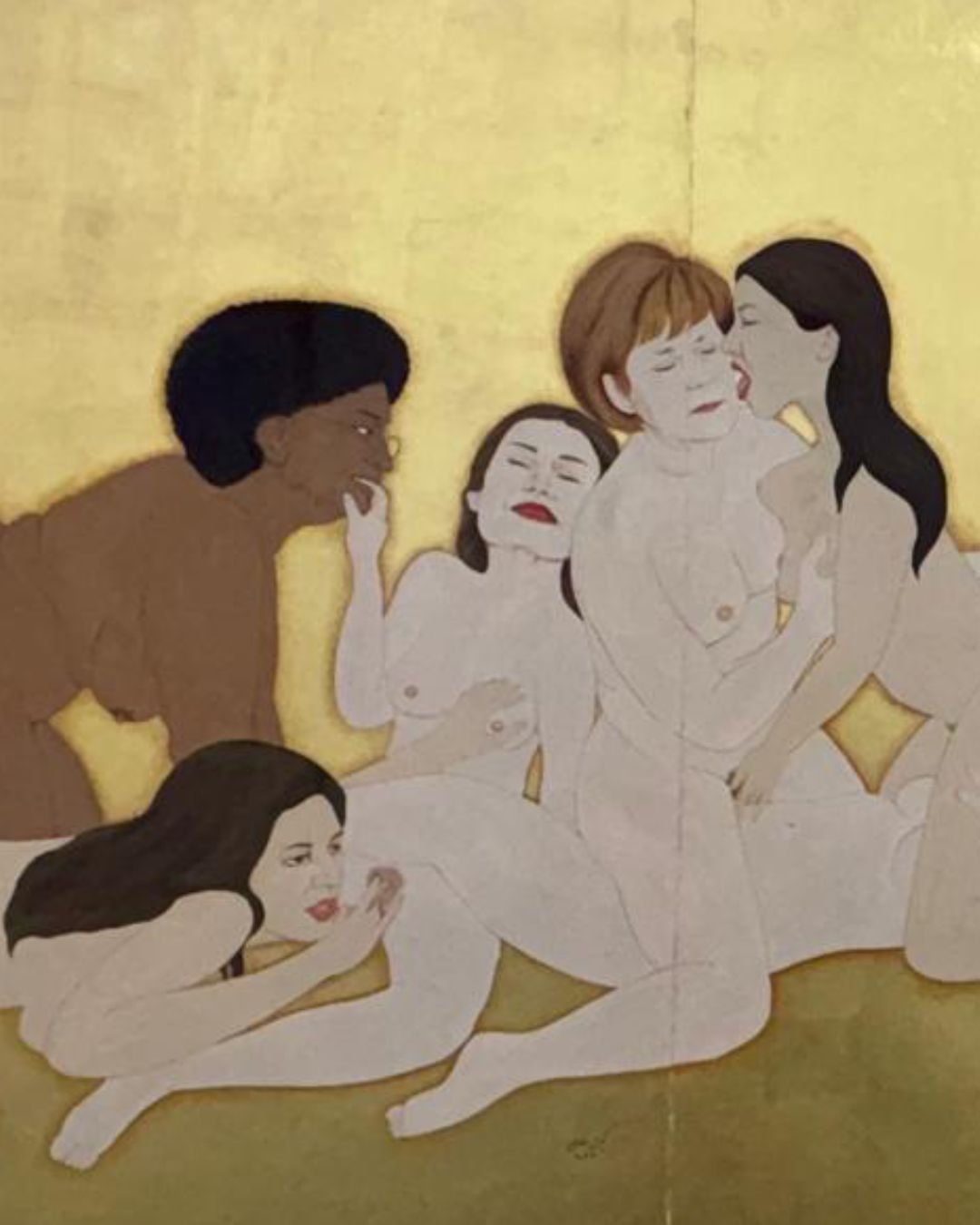
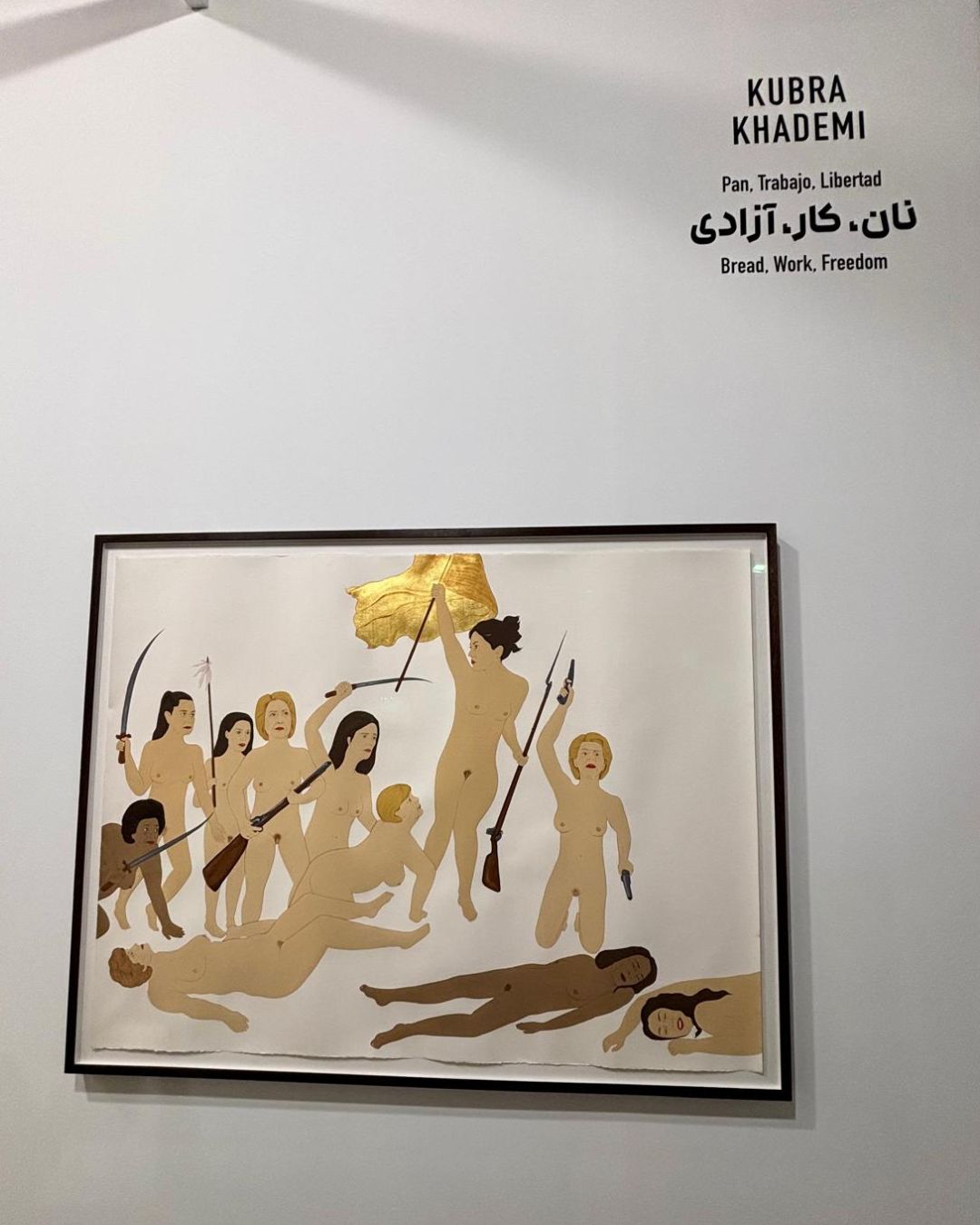
EB: So let’s look at the work itself. Khademi’s project, „Let us believe in the beginning of the hot season,“ is a series of gouache drawings, photo collages, and a film. It tells as already briefly mentioned the story of a romance between an American man and a Taliban leader.
CD: Which is already a provocative, almost scandalous idea. She’s taking these two opposing forces—the American and the Taliban—and imagining an intimate, romantic connection between them.
EB: And the way it was made is fascinating. She collaborated with an American artist, Daniel Pettrow, during the pandemic. They filmed their scenes separately on green screens—she in Paris, he in New York—and then edited them together. So the distance, the separation, is built into the very fabric of the film.
CD: So in a way medium repeats the message, formally I mean. The distance between the lovers is the distance between the two countries.
EB: And then there are the drawings. They’re these large-scale, colorful, almost mythological scenes. They’re not just illustrating the film; they’re expanding on it, deepening the story.
CD: So here, the context isn’t just a sad story. It’s a set of artistic choices. The collaboration across oceans, the use of green screens, the combination of film and drawing—these are all formal decisions. They’re not just about her biography.
EB: Exactly. And that’s where I think Frankel’s argument falls short. He’s worried about artists who use their trauma as a crutch. But Khademi is using her experience as a catalyst. She’s transforming it into a complex, multi-layered work of art.
CD: She’s not just telling us a sad story. She’s building a world. And that’s what art is supposed to do. It’s not just about reflecting reality; it’s about creating a new one.
EB: And her quote—“Let us believe in the beginning of the hot season“—is the perfect entry point. It’s not just a statement of hope. It’s an artistic manifesto. It’s a declaration that art can create new possibilities, even in the face of political despair.
CD: So maybe the problem isn’t the context itself. Maybe the problem is how we use it. Are we using it to shut down conversation, or to open it up? Are we using it to feel good about ourselves, or to understand the work more deeply?
EB: With Khademi, the context is essential. But it’s not the whole story. The story is in the colors, the lines, the collaboration, the allegory. It’s in the art.
CD: I read about her 18kg performance. You curated it for the Bauhaus Dessau, right? Can you describe it briefly? When was it again?
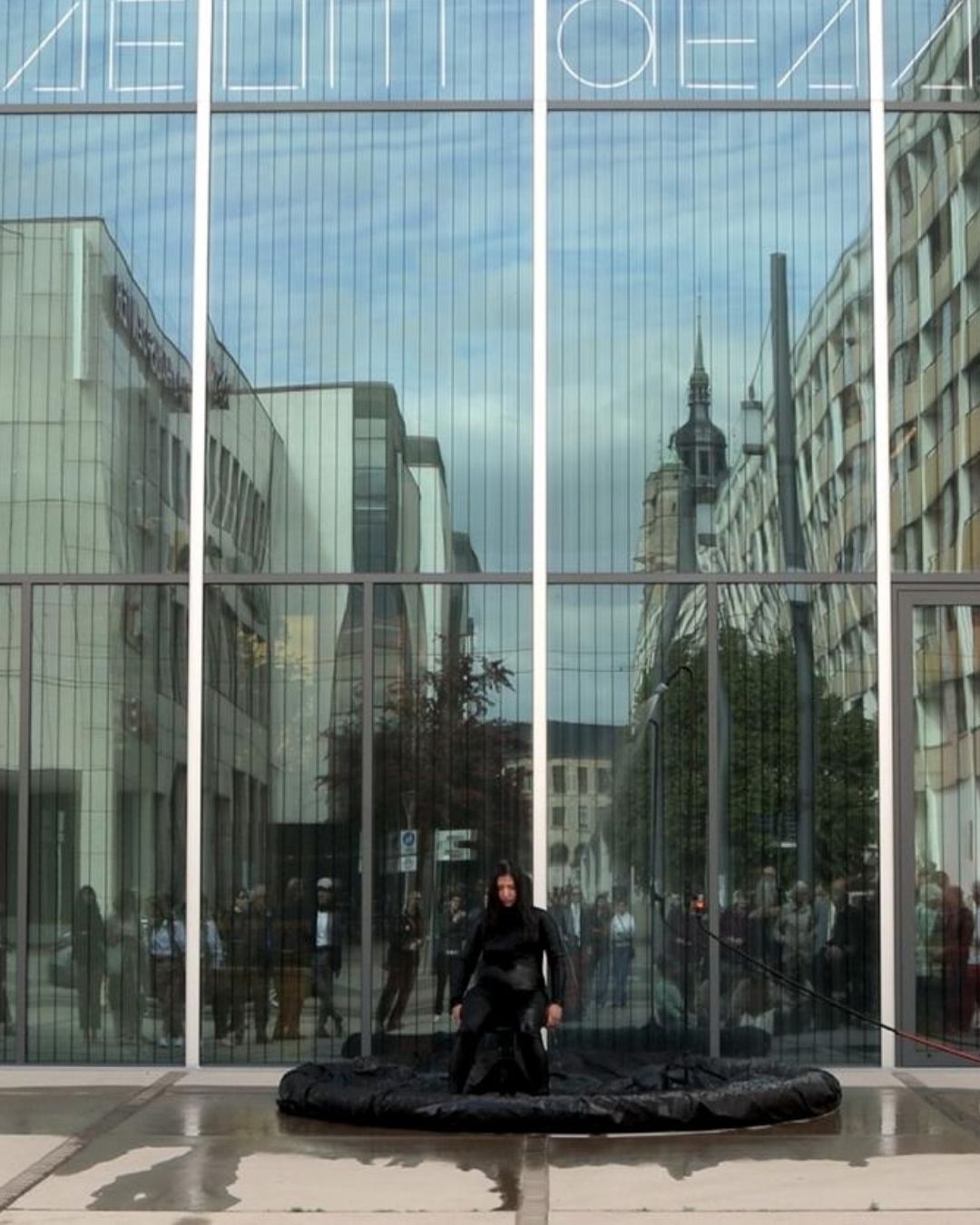
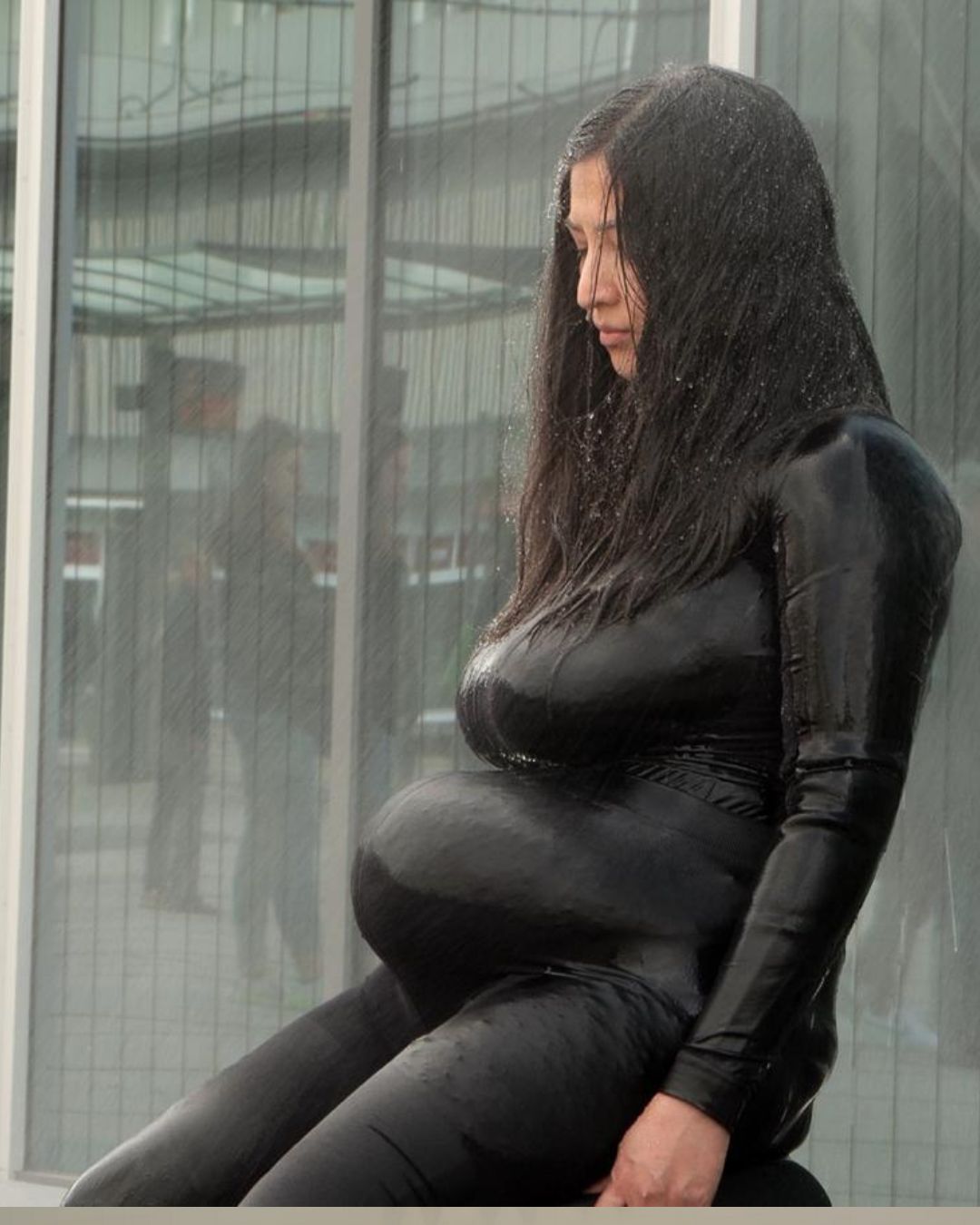
EB: Khademi´s 18kg Performance is perhaps one of her most important performances to date. She performed it at the Palais de Tokyo in Paris and when I talked to her about doing a performance “outside” of a museum, stepping outside of the white cube space and perform in public, the artist felt compelled to tell the story, or a journey that begins and continues within the earth, the mother earth, the female mother, the female body, the feminine body with curves – filled with salt. Khademi conveys a pregnant woman, a desired woman, a successful woman who gives birth, who gives life to a living being. And as the water slowly dribbles on her, the shape disappears slowly and gently in the presence of everyone; her presence, the audience and the water that was sinking into her body-earth, washes and demolishes her body. In a way, she is conveying the story of her mother. 18kg of salt stuffed in her body dissolves away. It was a significant moment especially since while Khademi’s performance took place, people walked by and reacted to it. An art performance turned into public performance.
CD: And what was that about her group exhibition “WIR at the Berlin Bundestag you mentioned the other day? I am curious to hear about that!
EB: Yeah, so to mark the 75th anniversary of the Basic Law, the Art Council of the German Bundestag has invited nineteen artists to explore fundamental rights. And Khademi´s contribution was about Article 5: Freedom of expression, arts and sciences: It shows a naked woman who is exposed to the gaze of her viewers without protection—beautiful and unharmed, but also overly explicit in its details. Beneath her lies a glistening pile of feces—a taboo breach even in German art and a stark contrast to the vulnerable beauty of th
____
Source/Citation quote: Farrokhzad, Forugh. „Let Us Believe in the Dawn of the Cold Season.“ Translated by Sholeh Wolpé. In Sin: Selected Poems of Forugh Farrokhzad. University of Arkansas Press, 2007. https://www.poetryfoundation.org/poems/162647/let-us-believe-in-the-dawn-of-the-cold-season.
____
Voice: Esenija Bannan & Charlotte Desaga.
Text: Charlotte Desaga.
Images from our private archives.