„Beauty is too easy. Often, I take beautiful objects and do extreme things to them so that they are overlaid with something a bit more sinister and violent.“ – Cornelia Parker A steamroller crushes thirty pieces of silver. A garden shed explodes. Pornographic tapes dissolve into ink. The British artist Cornelia Parker transforms everyday objects through extreme, violent processes. In this episode, we explore how destruction becomes creation, and why beauty alone is never enough.
 Available on Apple Podcasts & everywhere else — or right here ↓
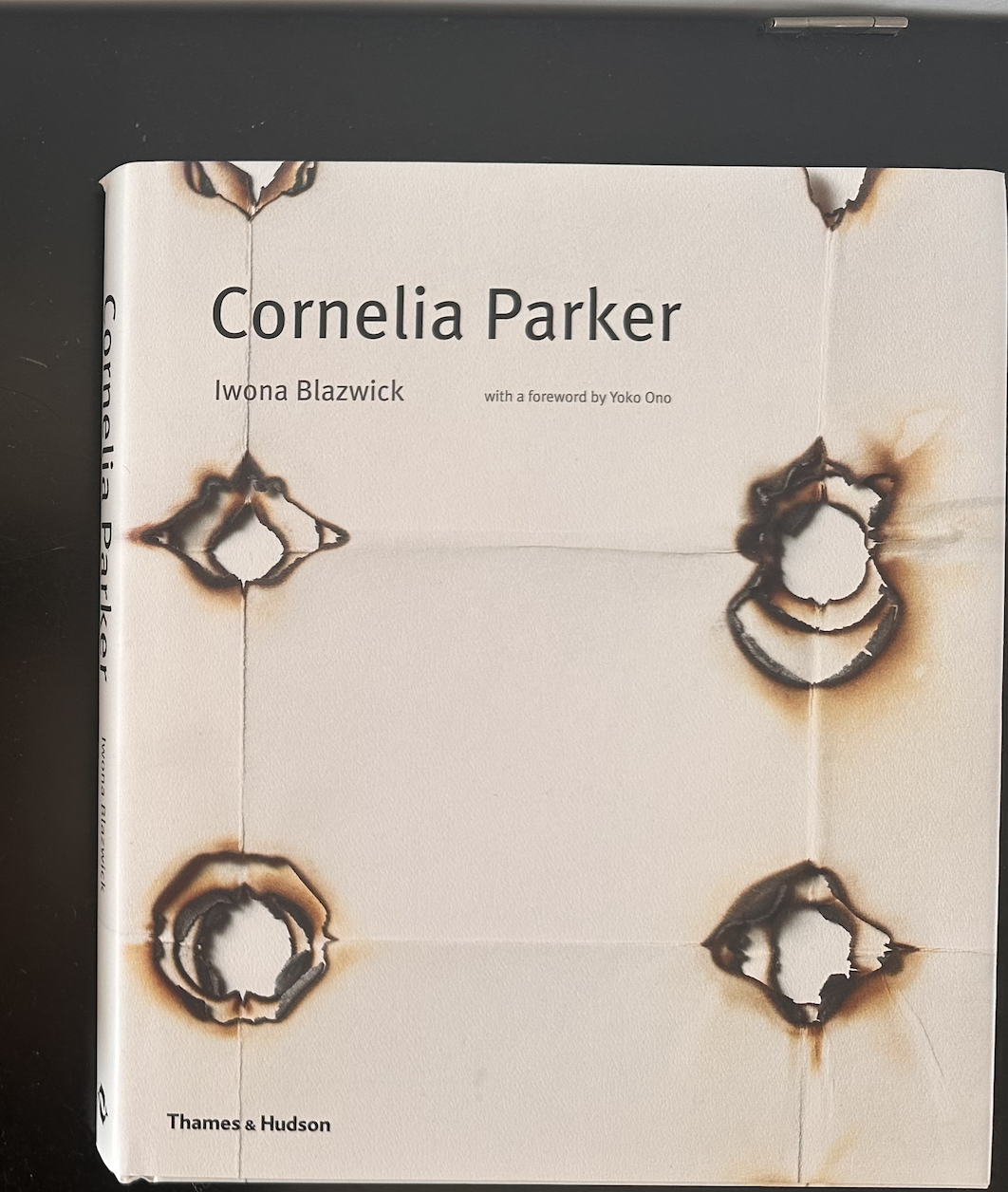
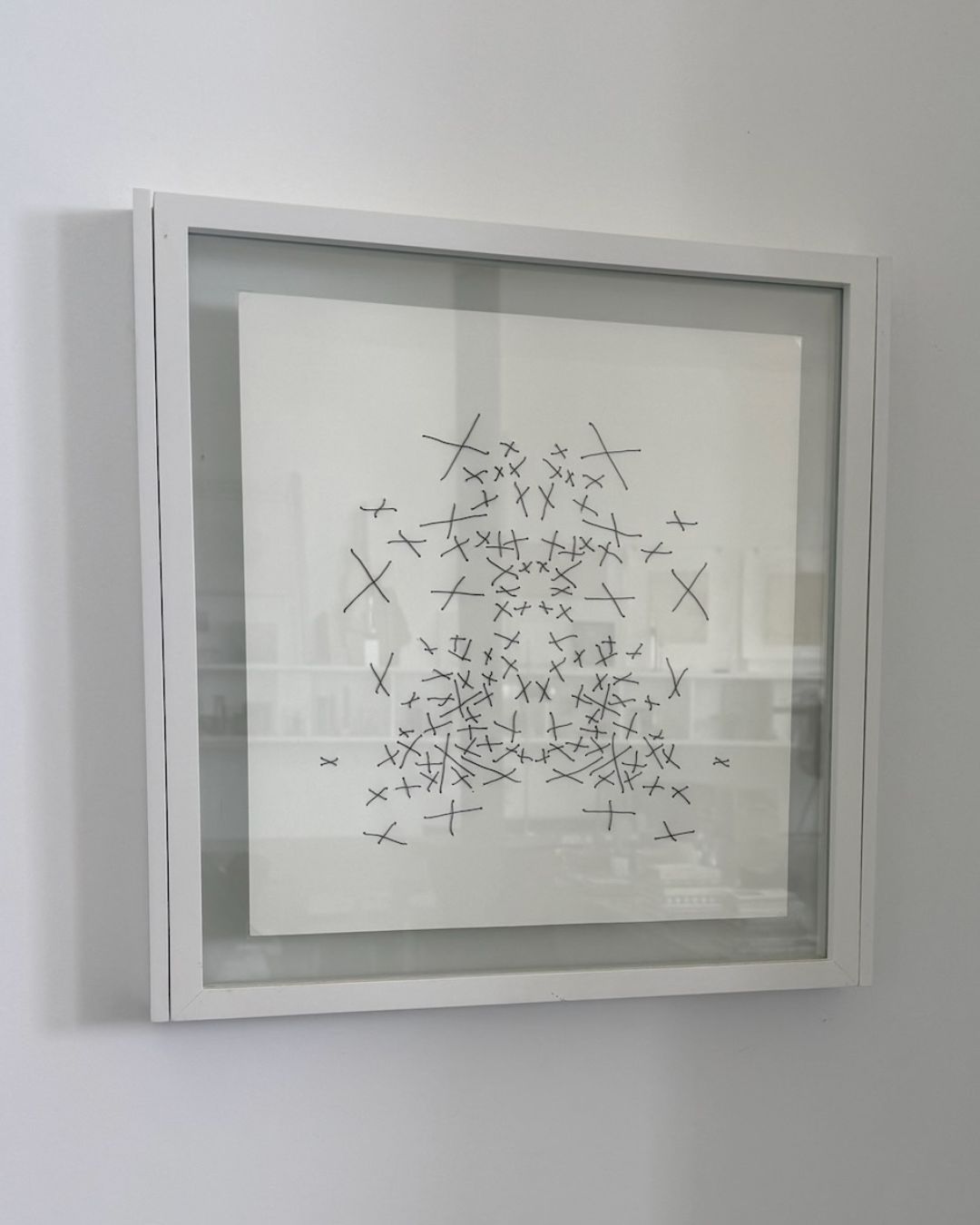
Selected works by Cornelia Parker from our archives
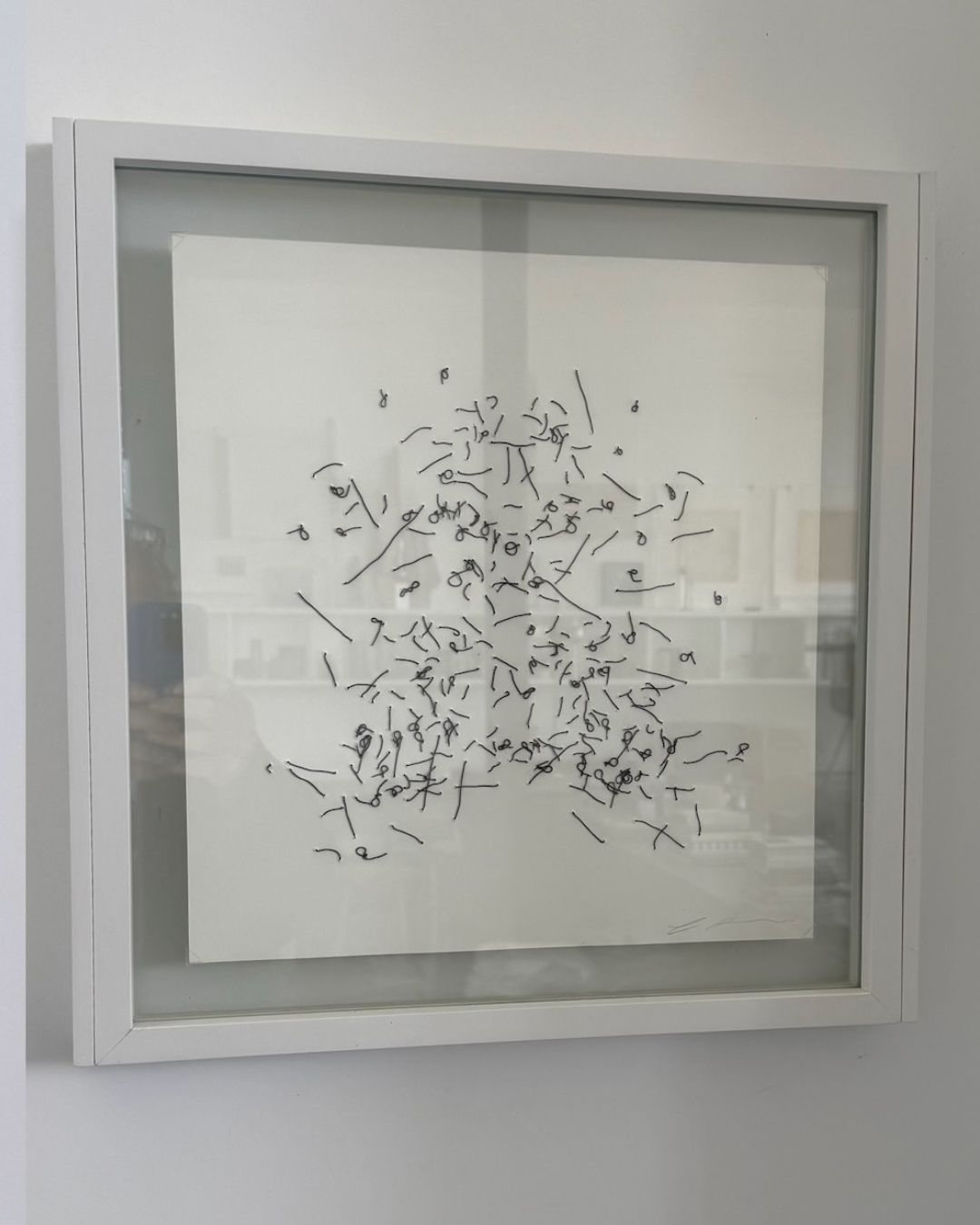
Transkript of Episode 07
Hosts: Charlotte Desaga (CD) & Esenija Banan (EB)
CD: Someone who prefers to remain unseen makes Art Unquoted possible. Their generosity is the invisible foundation of everything you hear. We dedicate this episode with deep gratitude.
EB: Welcome back to Art unquoted! It’s great to have you with us again. Today, we are focusing on an artist who knows perfectly well how to transform the ordinary into something spectacular. We are talking about the British artist Cornelia Parker, born in 1956. She takes everyday objects, things we are all familiar with, and subjects them to extreme, often violent processes. The result? Quite breathtaking!
CD: Spectacular and breathtaking, yes. But: Parker herself warns us against the superficial temptation of pure aesthetics. We chose a quote from her that perfectly captures this ambivalence. She says, „Beauty is too easy. Often, I take beautiful objects and do extreme things to them so that they are overlaid with something a bit more sinister and violent.“
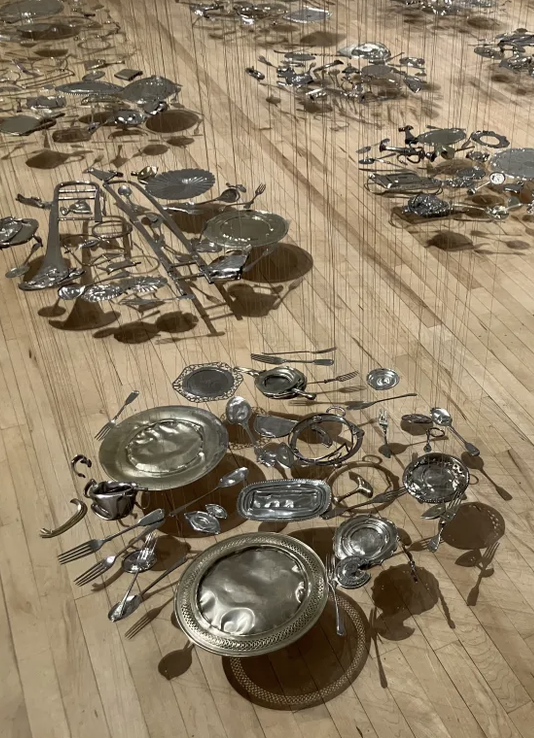
EB: Outstanding, truly. It describes her practice very accurately, that’s for sure. When I think of Thirty Pieces of Silver – those thirty silver objects, plates, candlesticks, spoons, which she had crushed by a steamroller. She literally flattened these valuable, historical items! And yet, or perhaps because of it, suspended in mid-air, they look so incredibly elegant and fragile. They hang there like hovering silver lily pads. For me, that is a magnificent act of liberating the objects from their original function.
CD: Liberation, yes, but at what cost? That is the core of Parker’s statement. The beauty you describe is the result of a traumatic act. A steamroller is pure, relentless mechanical violence. Parker often speaks of a cathartic, „tragicomic“ practice that is heavily influenced by her own fears and her Catholic upbringing. When she flattens thirty pieces of silver, she evokes the biblical betrayal of Judas. She gives these bourgeois status symbols a new, violent history. This is not just formal play; it is a performative archaeology of destruction.
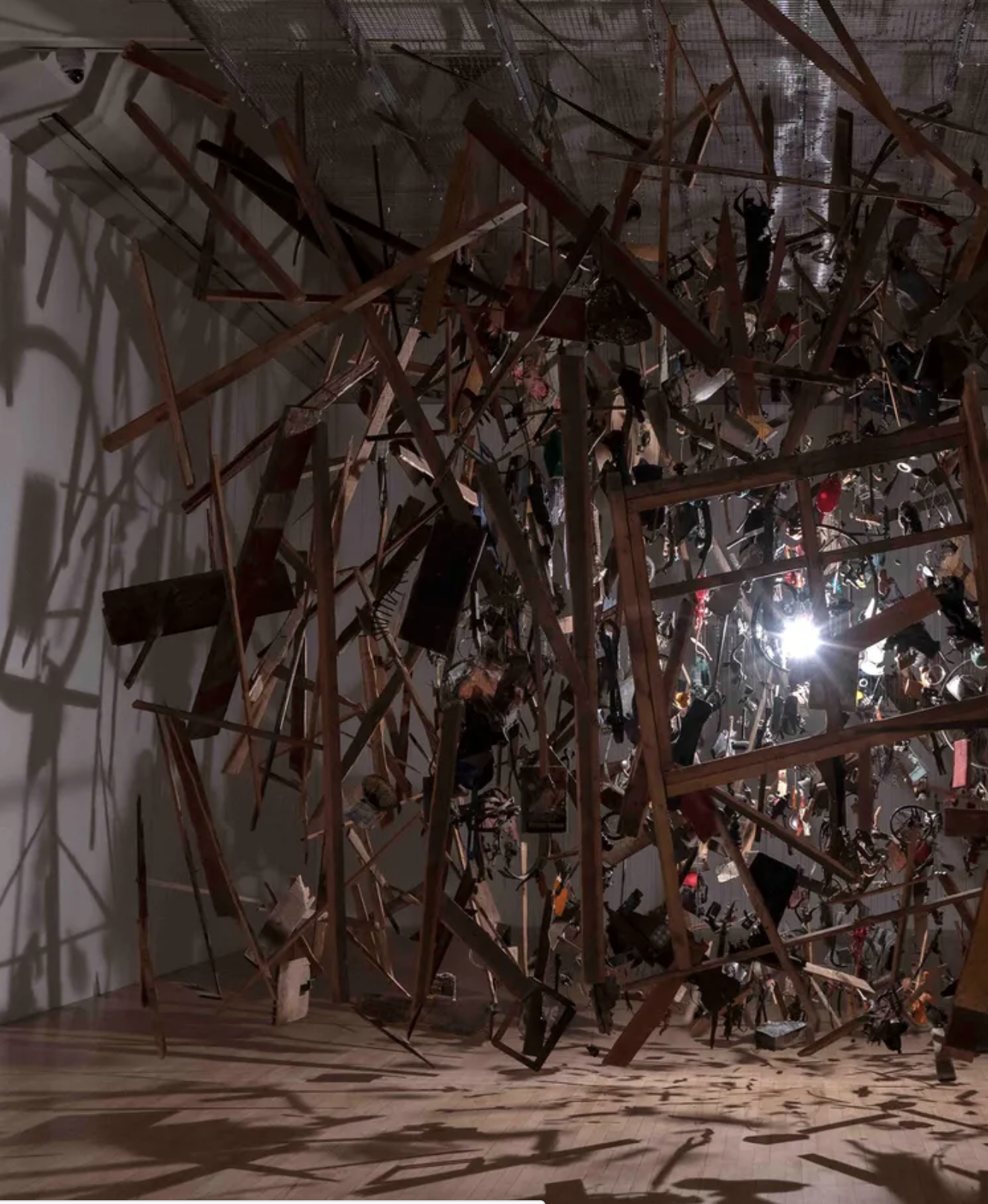
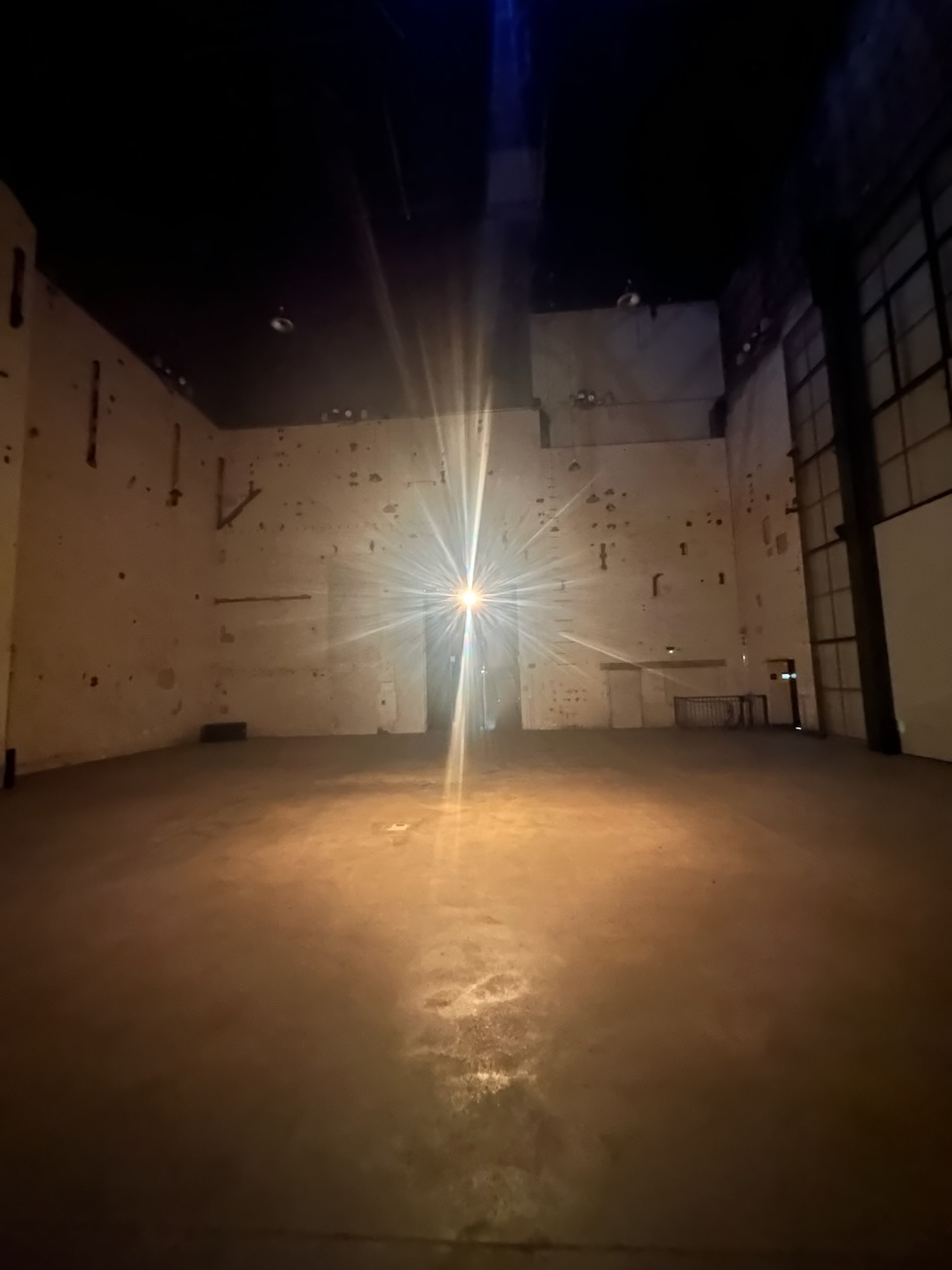
EB: But isn’t it exactly this destruction that creates the space for new associations? Let’s take what is probably her most recognized work: Cold Dark Matter: An Exploded View. She had the British Army blow up an ordinary garden shed full of everyday objects. And then she suspends the charred fragments exactly as if the explosion had been frozen in mid-air. A single lightbulb in the center casts dramatic shadows on the walls. It’s like a three-dimensional still from an action movie! She herself has said she loves these „cartoon deaths,“ like in Tom and Jerry, where characters explode and then reconstitute themselves. That has such incredible dynamic and energy!
CD: It remains dynamic, absolutely. But a shed is also a retreat, a personal safe space. Having it blown up by the military, the ultimate authority of state violence, is, above all, a massive intrusion. It is the visualization of the „uncanny,“ the sinister, as she calls it. Parker is fascinated by Freud’s psychoanalysis, describing the uncanny as the formerly familiar that has been alienated through repression. By having the shed explode, Parker forces us to acknowledge the latent violence simmering beneath the surface of our safe, bourgeois everyday lives. The shadows on the walls are not just dramatic; they are the ghosts of our own material existence.
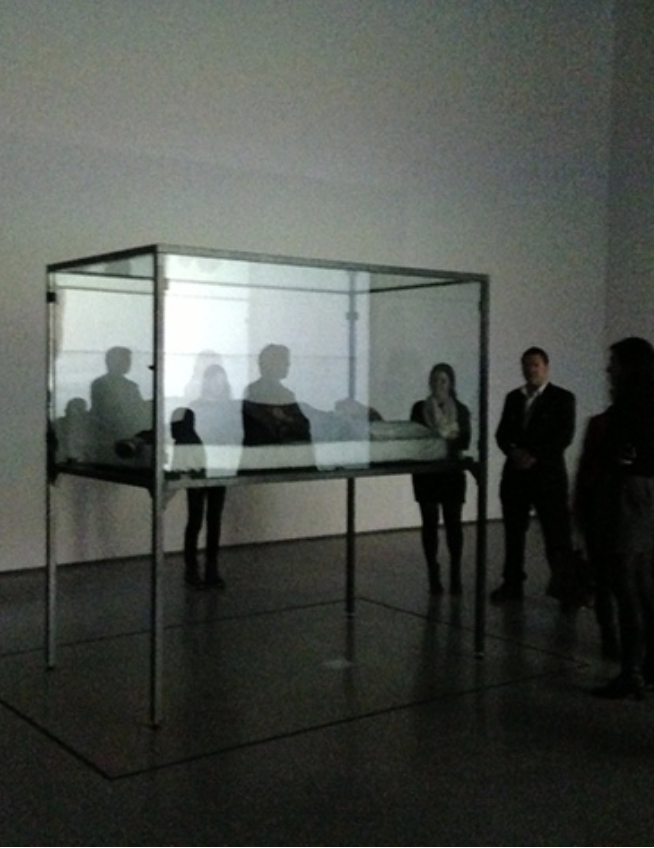
EB: That sounds very dark. But Parker herself constantly emphasizes the freedom of the viewer! She once said: „I think art is about freedom, and hopefully my work will have a very different meaning to each person who sees it. I don’t want it to have a fixed meaning…“ She loves ambiguity. You don’t exactly know which side you are on; you are confused, but in a good way! You can feel this freedom in The Maybe, too. Tilda Swinton sleeping in a glass case, surrounded by supposedly historical relics. That’s not just eerie; it’s fascinating, almost magical!
CD: The Maybe is an excellent example of this ambiguity. Tilda Swinton, alive, sleeping, vulnerable, exhibited like a specimen in a museum. Surrounded by relics that supposedly belonged to famous historical figures. Parker virtuously plays with our belief in the aura of objects here. But there is a layer of violence here, too: the voyeuristic gaze of the audience. The sleeper is defenseless. The institution of the museum becomes a place of surveillance. Parker evades a fixed meaning, yes, but she forces us to critically question our own positioning – our own gaze. We are accomplices in this act of exhibiting.
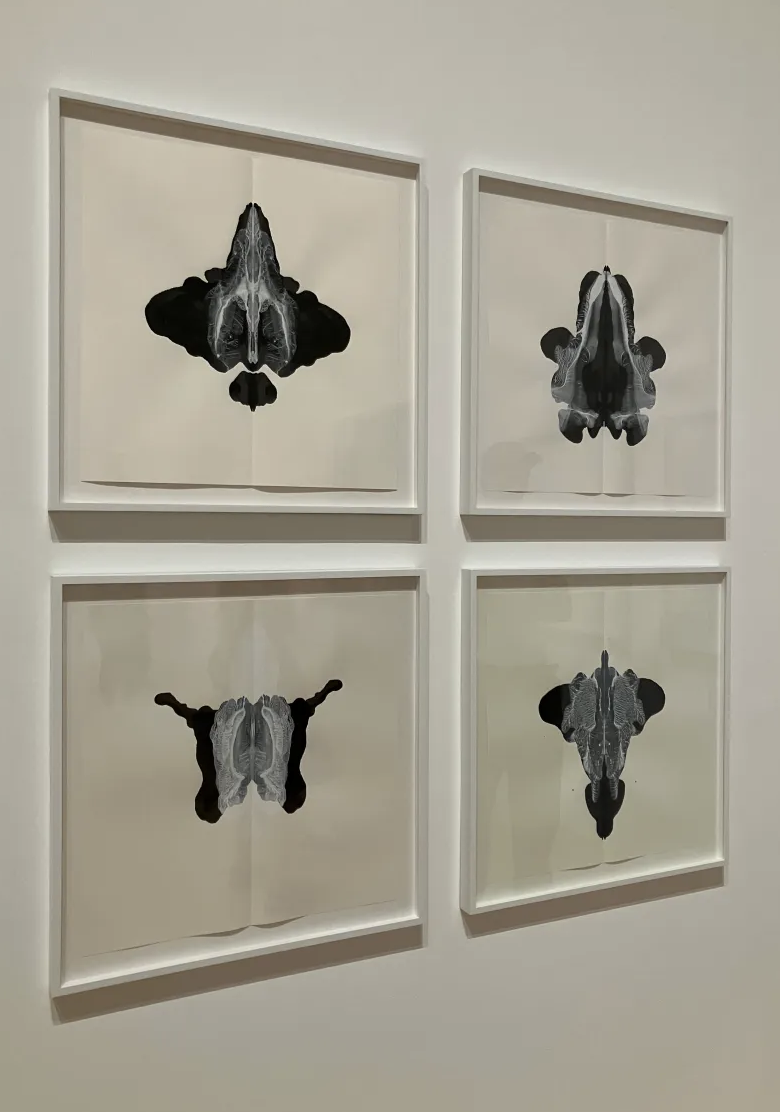
EB: I think you are looking at it too strictly! For me, Parker is an alchemist. She takes the trivial, the discarded, and gives it a completely new, often much more poetic existence through a radical cut as you see in The Maybe, which as the title already suggests, could be “anything” and evoke “any type of feeling” or “maybe” nothing at all. Think of the Pornographic Drawings. She takes confiscated pornographic videotapes, dissolves the ferric oxide of the tape, and turns it into ink for Rorschach tests. That is such a brilliant, almost humorous way of dealing with censorship and human abysses! She transforms something socially taboo into delicate, abstract drawings.
CD: It is an alchemical process, I agree with you there. But the origin of the material is crucial. The Rorschach tests, again a direct reference to psychoanalysis, target the subconscious. The fact that the ink consists of pornographic material is no coincidence. Parker calls such things „Avoided Objects.“ Things whose meaning is denied or socially marginalized. If we see sexual shapes in these abstract inkblots, it is our own subconscious reacting to the dissolved material. The beauty of the drawing is a trap that confronts us with our own repressions.
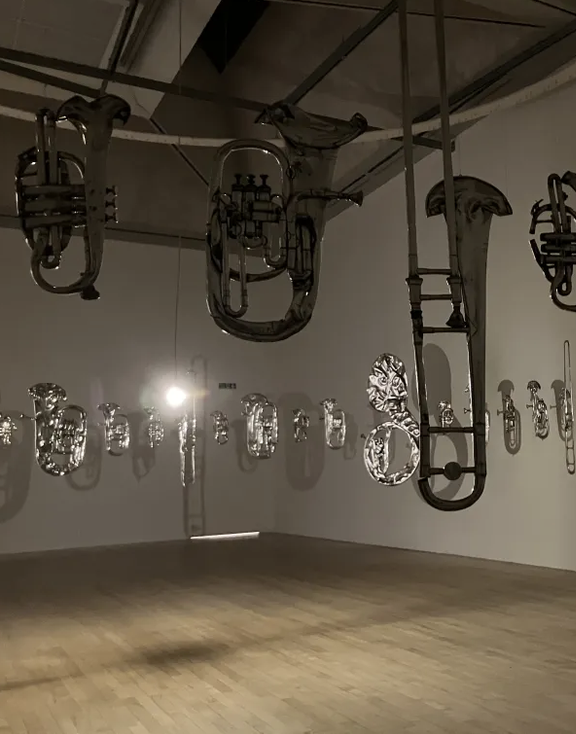
EB: A trap I gladly fall into! Because the visual experience is simply so strong. Her art may be deeply rooted conceptually, but she never forgets the viewer in the space. When you stand in front of Cold Dark Matter or beneath the suspended instruments of Breathless, those flattened brass instruments, it is primarily a physical, overwhelming experience. You feel the force that was applied, but you see the elegance of the result.
CD: The physical experience is undeniable. But we must not stop at the elegance of the result. „Beauty is too easy.“ If we only admire the suspended instruments, its reference to music or the gleaming silver of everyday objects, we ignore the steamroller and the explosive charge. Cornelia Parker forces us to accept destruction as an integral part of creation. She shows us that our everyday world and our objects always carry the potential for violence within them – and that true art emerges precisely at this point of friction.
EB: And exactly this friction is what makes her works so unforgettable.
CD: Yes, exactly: She destroys in order to recreate, and leaves us in awe. EB: See you next time!
____
Source/Citation quote: „Hay 2013: Artist Cornelia Parker on five works and the pieces that inspired them,“ The Telegraph,
2013, https://www.telegraph.co.uk/culture/art/10077197/Hay-2013-Artist-Cornelia-Parker-on-five-works-and-the-pieces-that-inspired-them.html.
____
Texts by Charlotte Desaga. Semi-automatically translated.
Images from our private archives.